Understanding Sports Card Market Values: A Collector's Guide to Pricing
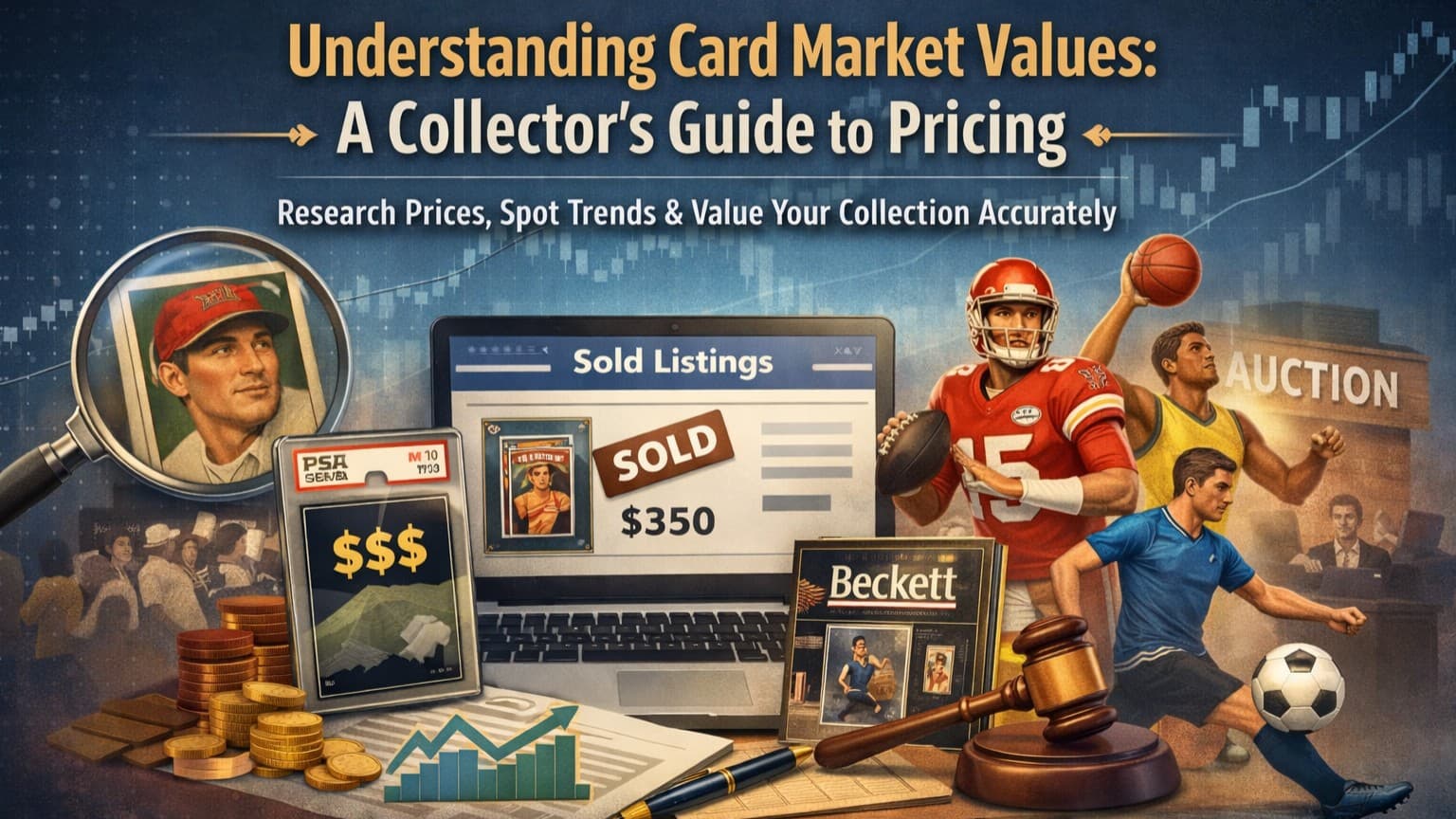
Understanding Sports Card Market Values: A Collector's Guide to Pricing
How to research prices, spot trends, and value your collection accurately
Quick answer
Sports card values come from what buyers actually paid, so start with eBay sold listings for the exact card and condition, use the median of the last 30 to 90 days, and ignore outliers and asking prices. Player performance, condition, scarcity, historical significance and market sentiment move prices, and fees come off the top when you sell.
How Sports Card Values Actually Get Set
"What's my card worth?" It's the most common question in collecting, and the answer is rarely simple. Card values move constantly, pushed by everything from a player's Sunday performance to broader economic conditions.
Here is how to value your cards without guessing.
Where to Research Card Prices
eBay Sold Listings (The Gold Standard)
eBay's completed sales data is the most reliable pricing source:
- Search for your card, and be specific about year, brand, and card number
- Filter by "Sold Items"
- Look at the last 30 to 90 days of sales
- Ignore the outliers, both high and low
- Find the median price for your card's condition
Asking prices mean nothing. Only completed sales show what buyers actually pay.
Price Guides and Databases
- PSA Price Guide: based on APR (Average Price Realized)
- Beckett: the traditional hobby standard
- Card Ladder: tracks population and sales data
- 130 Point: aggregates eBay sales data
One caveat: database prices often lag the market by weeks or months.
Auction Houses
For high-end cards, check recent auction results:
- Heritage Auctions
- PWCC
- Goldin
- Lelands
These set the market for premium cards, but they do not reflect typical collector transactions.
Factors That Influence Card Value
 Factors That Influence Sports Card Value
1. Player Performance
Nothing moves card prices like what happens on the field or the court:
- Rookie seasons: breakout performances spike prices
- Championships: winning a title lifts all of a player's cards
- MVP and awards: major awards create demand surges
- Injuries: can suppress values temporarily, or permanently
- Retirement: often stabilizes prices
For example, Patrick Mahomes' rookie cards 10x'd after his first Super Bowl win.
2. Condition (Grade)
We covered this in depth elsewhere, but the short version:
| Raw Card Condition | Approximate Value vs. Graded |
|---|---|
| Pack fresh | 40-60% of PSA 10 |
| Light wear | 20-30% of PSA 10 |
| Moderate wear | 10-15% of PSA 10 |
| Heavy wear | 5% or less of PSA 10 |
The grading premium is real. A raw card valued at $100 might be worth $400 or more in a PSA 10 slab.
3. Scarcity and Print Runs
Supply drives a lot of this:
- Base cards: highest print runs, lowest values
- Parallels: numbered cards command premiums
- 1/1s: unique cards with collector-set prices
- Short prints: intentionally limited production
Modern cards often list print runs directly. "/99" means 99 copies exist.
4. Historical Significance
Some cards sit outside normal valuation:
- First cards (1952 Topps pioneered the modern card)
- Rookie cards of all-time greats
- Error cards with documented mistakes
- Cards featuring iconic moments
5. Market Sentiment
The broader market affects every card:
- Economic conditions: recessions suppress luxury spending
- Media attention: documentaries and news coverage drive interest
- Generational nostalgia: as collectors age, their childhood cards rise
- New collector influx: 2020-2021 saw a wave of new interest
Common Pricing Mistakes
1. Using Asking Prices
That card listed for $500? It means nothing until it sells. Always check sold listings.
2. Ignoring Condition
Your raw card is not worth PSA 10 prices. Be honest about condition.
3. Overvaluing Commons
Most cards, even of great players, are worth $1 to $5. Not every card is valuable.
4. Cherry-Picking Comps
Don't find one high sale and assume that's the value. Look at median prices across several sales.
5. Forgetting Fees
When you sell, remember:
- eBay: 13.25% final value fee
- PayPal and payment processing: 2.9% plus $0.30
- Shipping: $4 to $5 minimum
A $100 sale nets you roughly $80.
Building Value in Your Collection
Buy Smart
- Grade matters more than quantity.
- Key rookies hold value better than commons.
- Condition decides the price. A few nice cards beat a box of damaged ones.
- Buy what you love. Passion protects against market swings.
Sell Smart
- Time your sales. Sell during hot streaks.
- Grade first. High-value raw cards often benefit from grading.
- Use good photos. Better listings get better prices.
- Write accurate descriptions. That is how you build buyer trust.
DCM's Role in Valuation
DCM helps you understand value by:
- Assessing condition. You get four subgrades and the reason behind each deduction.
- Pulling eBay data. See recent sold prices for similar condition.
- Working quickly. Get through a large collection in one sitting.
- Sorting submissions. See which cards look like the better candidates before you mail anything away.
Example Workflow
- Photograph your card with DCM
- Get the condition grade (for example, "Near Mint, likely PSA 8")
- Check eBay sold listings for that card in PSA 8
- Now you have a value range you can defend
- Send it to eBay with InstaList, which builds the listing for you with graded card images, labels, a formatted description and the report attached
 Instantly List Sports Cards to eBay with DCM
Price Trends to Watch
- Vintage is stabilizing after the 2021 peaks
- Modern rookies are highly volatile
- Soccer and international cards are growing in the US market
- Women's sports cards are gaining collector interest
- Basketball remains the strongest market segment
The Bottom Line
Card values are not fixed. They are a moving target, pushed by more factors than any one collector tracks. The best collectors:
- Research thoroughly before buying or selling
- Understand how condition drives value
- Follow market trends without panic-selling
- Focus on cards they genuinely enjoy
- Use DCM to make informed decisions
Know your collection's value. Start grading with DCM and get the condition detail you need to price your cards correctly.
Frequently asked questions
- What is the most reliable source for card prices?
- eBay sold listings filtered to the exact card and condition. Asking prices and database guides lag the market or reflect wishful thinking.
- How much does condition change a card's value?
- Often more than anything else. The same card can trade for multiples between a mid grade and a Gem Mint, which is why an honest grade matters before you price it.
- What pricing mistakes do collectors make most?
- Using asking prices, ignoring condition, overvaluing common cards, cherry-picking the highest comp and forgetting seller fees.